
There is a quiet narrative that follows many veterans and emergency service personnel once they leave service or begin to struggle with the impact of their experiences.
It is rarely stated openly, but it often underpins conversations, systems, and even how some support services frame recovery.
The narrative suggests that after trauma, injury, or prolonged stress, a person becomes “broken.”
For some veterans and emergency services, this idea can slowly take hold. Experiences such as operational stress, exposure to trauma, physical injury, or the loss of identity that can come with leaving service can begin to feel like permanent fractures in a person’s life.
But describing someone as broken does not reflect the reality of human resilience.
A helpful way to understand this comes from a centuries-old Japanese philosophy known as Kintsugi.
The Philosophy of Kintsugi
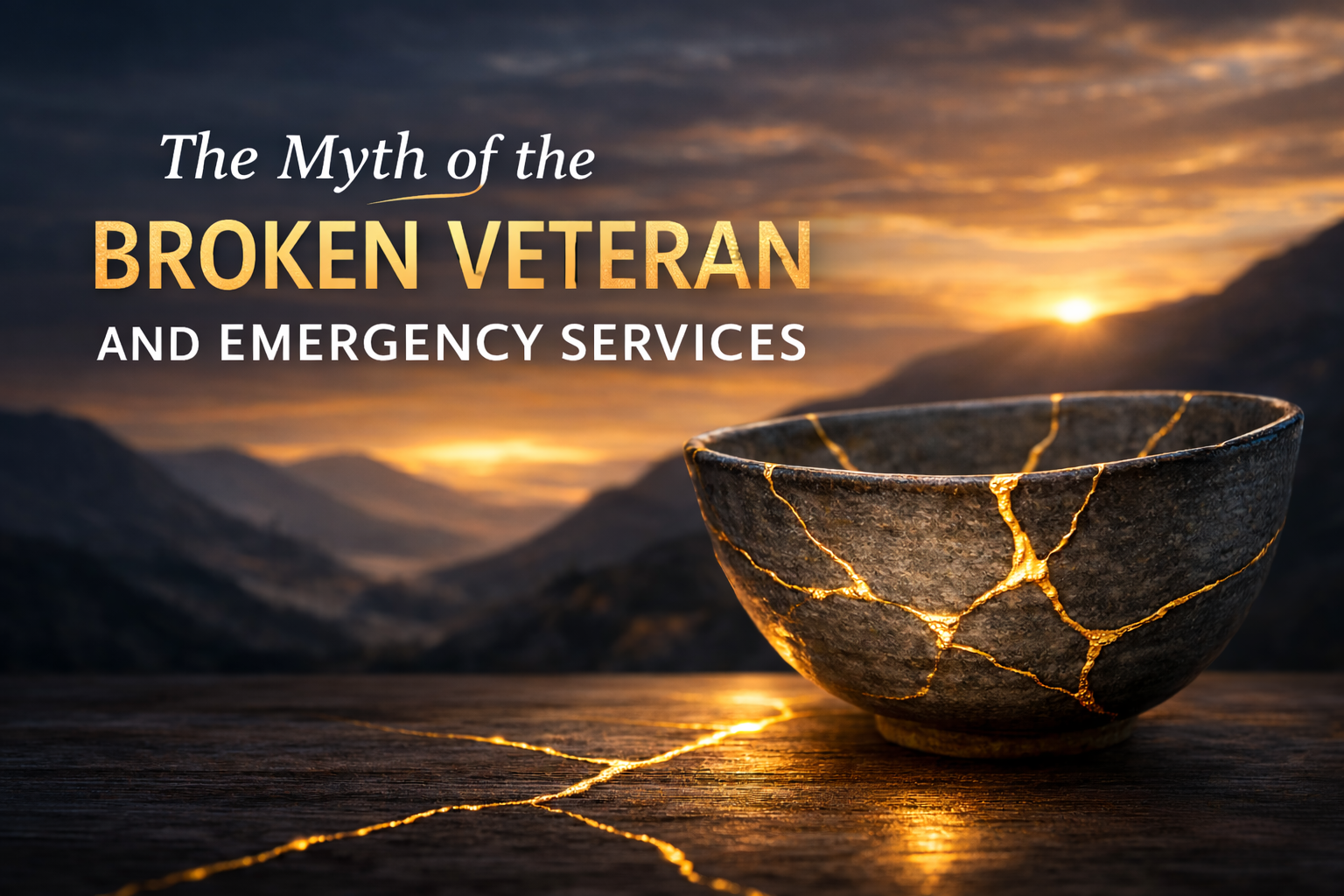
Kintsugi is the traditional Japanese art of repairing broken pottery.
Instead of hiding cracks or trying to restore an object to look new again, artisans repair the fractures using lacquer mixed with powdered gold. The cracks remain visible and are intentionally highlighted.
The result is something remarkable.
The repaired piece often becomes more distinctive and more valued than it was before it broke, because the fractures now tell a story of resilience, repair, and history.
Kintsugi is built on a powerful idea:
Breakage and repair are not something to hide. They are part of the object’s story.
This philosophy provides a useful way to think about recovery and wellbeing, particularly for those who have spent years in demanding service environments.
Service Leaves Its Mark
Military and emergency service careers involve responsibilities and environments that most professions never encounter.
Personnel may regularly face:
- high-risk operational environments
- repeated exposure to trauma
- responsibility for the safety of others
- prolonged stress and high-pressure decision-making
- ethical challenges and life-altering events
These experiences inevitably shape the people who serve.
Over time, they build qualities that are widely recognised in the veteran and emergency services communities: resilience, discipline, leadership, loyalty, and an ability to function under pressure.
But it is also natural that these environments can leave emotional, psychological, or physical strain.
Acknowledging that strain is not a sign of weakness. It is a recognition of the reality of service.
Just as pottery can crack under pressure, people who carry significant responsibility for long periods can experience strain. But strain is not the same thing as being irreparably broken.
The Problem With the “Broken” Narrative
Language shapes perception.
When individuals begin to see themselves as broken, it can lead them to believe that their experiences have permanently diminished their value or capabilities.
Unfortunately, this narrative has become common within some parts of the broader veteran and emergency service support landscape.
In some cases, the “broken story” is being reinforced by systems, programs, and organisations that frame the cohorts primarily through the lens of damage or deficit.
When this narrative dominates, recovery can begin to feel like something that must be constantly managed rather than something that allows a person to rebuild and move forward.
There is also a difficult truth worth acknowledging.
Some parts of the support ecosystem, intentionally or not, can become financially dependent on the idea that veterans and emergency services are permanently broken.
When support models rely on individuals remaining in a state of ongoing crisis, the incentive to change that narrative can become complicated.
Keeping people defined by their damage does not necessarily help them move forward.
And that is where a different perspective becomes important.
Trojans Trek – Kintsugi
At Trojan’s Trek, one of the philosophies that guides how recovery is viewed is closely aligned with the idea of Kintsugi.
The focus is not on seeing veterans and emergency services personnel as damaged individuals who need to be fixed.
Instead, the perspective is that service experiences, both the strengths and the challenges, become part of a person’s story.
Just like Kintsugi pottery, the fractures are not erased.
They are acknowledged, understood, and integrated into the broader narrative of someone’s life.
Recovery then becomes less about returning to who someone once was and more about building a healthy and meaningful life that includes those experiences.
Recovery as Integration
For many veterans and emergency services, the challenge is not only managing the impact of trauma or stress.
It is also navigating a shift in identity.
Service often provides a strong sense of structure, belonging, and purpose. When that chapter changes, individuals may begin asking deeper questions:
- Who am I outside of my role in service?
- What values guide my life now?
- What direction does the next chapter take?
These are important and healthy questions.
Rather than viewing service as something that ended abruptly, many of Trojans Trek participants eventually come to see it as one chapter in a larger life story.
The qualities developed through service, discipline, resilience, leadership, and teamwork do not disappear once the uniform comes off.
They remain part of the individual.
The Strength Within the Story
The idea that veterans and emergency services are “broken” overlooks a fundamental reality.
Those who serve often do so in environments that demand extraordinary resilience.
Experiencing difficulty after carrying those responsibilities does not erase the strength that existed before.
If anything, it highlights the depth of the experiences they have carried.
Kintsugi reminds us that cracks are not simply damage.
They are evidence of pressure endured and a story lived.
When those cracks are acknowledged and integrated into a broader understanding of oneself, they can become part of a stronger, more complete identity.
Moving Beyond the Broken Narrative
The myth of the broken veteran and emergency services does not serve the people who have served.
It reduces complex lives and experiences to a single label.
A more helpful perspective recognises that recovery is not about fixing something that is permanently damaged.
It is about supporting individuals to understand their experiences, reconnect with their values, and continue building a life that holds purpose, connection, and wellbeing.
The philosophy of Kintsugi offers a powerful reminder.
The cracks are not something to hide.
They are part of the story.
And sometimes, when seen through the right lens, those very cracks reveal the strength that was always there.
