
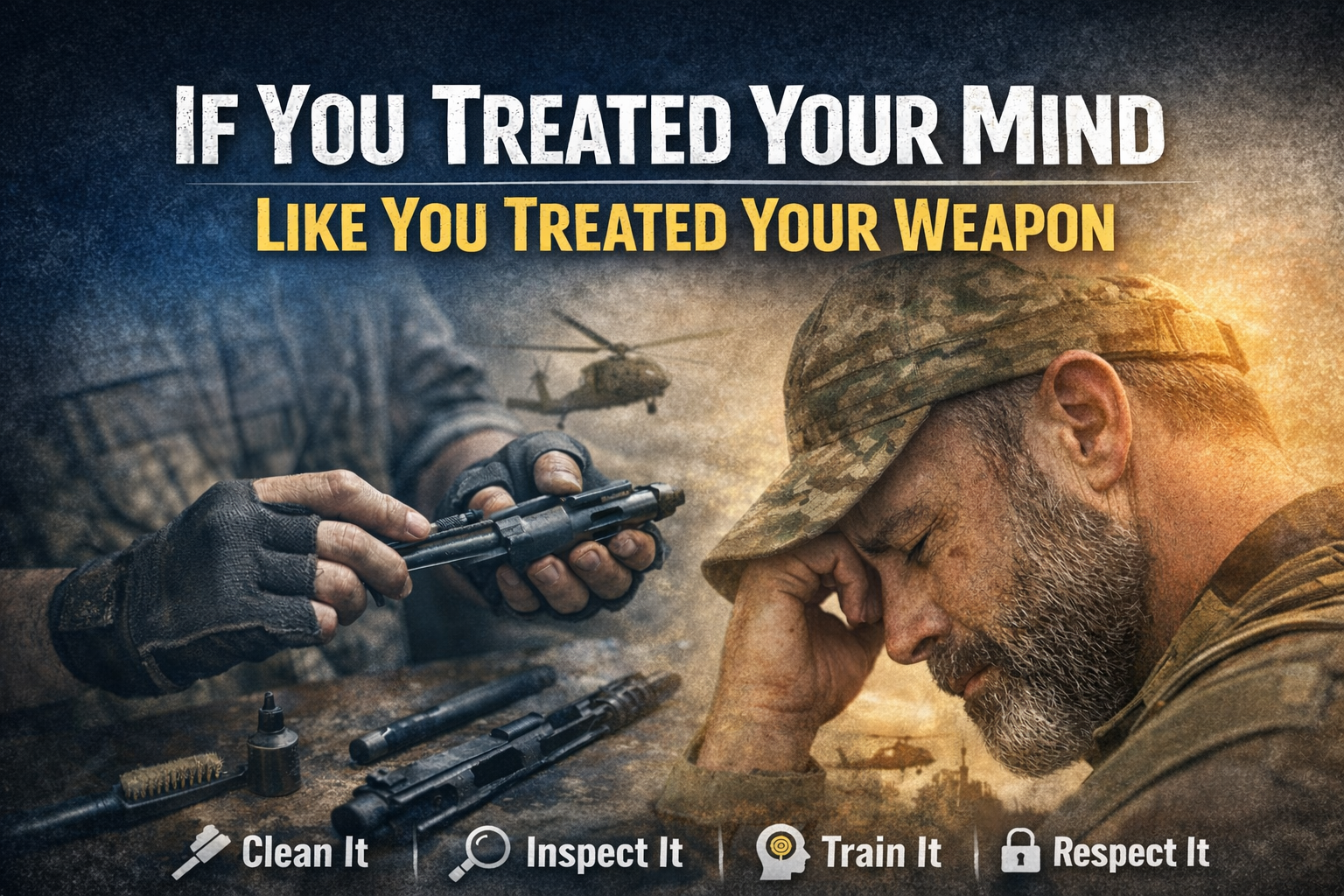
There was a time when your weapon was an extension of you.
It wasn’t just issued equipment. It was a responsibility. It was discipline. It was trust. You cleaned it meticulously. You stored it securely. You trained with it repeatedly. You respected its power because you understood the consequences of neglect.
A dirty weapon jams. A neglected weapon misfires. A complacent operator becomes a liability.
Now here’s the uncomfortable question:
What if you treated your mind with the same standard?
Because whether you’re still serving or long out of uniform, the most powerful and potentially destructive-weapon you’ve ever carried has never been in your hands.
It’s been between your ears.
Maintenance Is Not Optional
In service, maintenance wasn’t negotiable. After use, you stripped your weapon down. You inspected every component. You removed carbon buildup. You checked for cracks, corrosion, and wear. You reassembled it carefully and function-tested it before it ever went back into storage.
You didn’t do this because it was exciting.
You did it because failure wasn’t an option.
Yet most people never “strip down” their thinking.
We accumulate residue every day. Stress from work, frustration from relationships, guilt from the past, anxiety about the future, and anger from unresolved conversations. Add in a constant stream of news, social media, and other people’s opinions, and the buildup becomes thick.
But we rarely stop to inspect it.
Instead, we push through. We tell ourselves we’re fine. We distract. We suppress.
Then one day, under pressure, something jams.
An overreaction. Anxiety that feels overwhelming. An outburst that surprises even us. A withdrawal from people we care about.
It’s not weakness.
It’s poor maintenance.
You Are Responsible for What You Load
You were trained to understand what you were loading into your weapon. Ammunition wasn’t random. It was specific. It had purpose. It had impact.
Yet when it comes to the mind, we often load indiscriminately.
We scroll through outrage. We consume fear-based headlines. We replay painful memories. We internalise criticism. We compare ourselves endlessly.
Every piece of content, every conversation, every unchecked belief becomes ammunition.
If you constantly load fear, you will fire anxiety. If you constantly harbour resentment, you will fire anger. If you constantly load inadequacy, you will fire self-doubt.
Mental discipline begins with intentional loading. What you allow into your mind shapes how you respond to the world.
You wouldn’t recklessly chamber rounds.
Why recklessly chamber thoughts?
Weapons Discipline Has a Psychological Parallel
The principles drilled into you were simple but absolute:
- Keep your finger off the trigger until ready to fire.
- Know your target and what’s beyond it.
- Never point it at something you do not intend to destroy.
These aren’t just tactical rules. They are psychological ones.
Keep your finger off the trigger. Not every thought requires immediate action. Not every emotion requires expression. Reaction is not the same as control.
Know your target and what’s beyond it. When you discharge your frustration at home because work overwhelmed you, what’s beyond that target? Your partner. Your children. Their sense of safety.
Never point it at something you do not intend to destroy. Self-talk is powerful. Repeatedly aiming harsh criticism at yourself eventually damages confidence, identity, and purpose.
Without mental discipline, you become both operator and casualty.
Secure Storage: Processing the Past
Weapons are secured properly because unsecured weapons are dangerous.
Crappy events, however, are often handled in one of two extremes: buried or left loaded.
Some people suppress everything, convincing themselves that silence equals strength. Others relive experiences repeatedly without ever truly processing them.
Neither approach is safe.
Processing your experiences, through conversation, writing, reflection, or professional support, is not about reliving pain. It’s about safe handling.
Debriefing was standard operational practice. You reviewed what happened, what worked, what didn’t, and what needed adjustment.
Yet many never debrief their own lives.
Unprocessed experiences don’t disappear. They sit in the system, safety off, waiting for the right trigger.
Secure storage requires courage.
But it prevents accidental discharge.
Skill Degrades Without Training
No one qualified once and stopped training. Skill is perishable. Repetition builds competence under stress.
Mental resilience is no different.
Breathing techniques under pressure. Intentional pauses before responding. Reflection at the end of the week. Time in stillness. Conversations that confront difficult truths.
These practices are not signs of fragility. They are training repetitions.
Without them, reaction replaces response. Emotion overrides judgment. Stress accumulates unchecked.
With them, clarity sharpens.
Identity After the Uniform
In service, identity was clear. Rank, role, mission, structure, and tribe provided definition.
When that structure shifts or disappears, many experience disorientation. The mind begins filling gaps with narratives:
“I’ve lost my purpose.” “I was better back then.” “I don’t belong anymore.” “No one understands.”
Unchecked narratives become beliefs. Beliefs become identity. Identity drives behaviour.
Maintaining your mind means examining the story you are telling yourself.
Is it accurate? Is it useful? Is it complete?
Or is it residue from a chapter that has ended?
The Spiritual Layer
The mind is not only a tactical tool. It is the lens through which you interpret reality.
If that lens is clouded by unresolved pain, constant noise, or negative self-perception, the world appears hostile, even when it isn’t.
Cleaning the lens changes perception.
This is not about pretending life is easy. It is about recognising that interpretation shapes experience.
The same discipline that once made you operationally effective can make you internally grounded.
Precision. Awareness. Responsibility. Intentionality.
These qualities do not expire with a discharge date.
They transfer.
A Different Standard
Imagine holding your mental life to the same standard you once held your equipment:
- Conduct regular self-debriefs.
- Identify emotional triggers.
- Replace faulty beliefs.
- Limit exposure to corrosive inputs.
- Prioritise recovery and rest.
- Train consistently, not reactively.
This is not about becoming softer.
It is about becoming stable.
Grounded people are not weak. They are controlled. Measured. Intentional.
Just like a disciplined operator.
Final Reflection
An unmaintained weapon is dangerous.
An unmaintained mind is catastrophic.
It affects relationships. Health. Leadership. Legacy.
The discipline required to maintain your internal world is not new to you. It is already embedded in who you are. It simply needs to be redirected.
If you treated your mind the way you treated your weapon, you would clean it regularly. Inspect it honestly. Store it safely. Train it consistently. Respect its power.
And in doing so, you might discover that the greatest strength you ever carried was never external.
It was your capacity for disciplined self-leadership.
The most powerful weapon you will ever handle is your mind.
Handle it accordingly.
