
Most people believe identity is fixed.
They think it’s something carved into stone somewhere around the time they were ten years old.
You’re the smart one. You’re the troublemaker. You’re the quiet one. You’re the soldier. You’re the broken one. You’re the one who never quite got it together.
And somewhere along the way, that description stops being a moment in time and starts becoming who you believe you are.
The truth is, most people never stop long enough to consider:
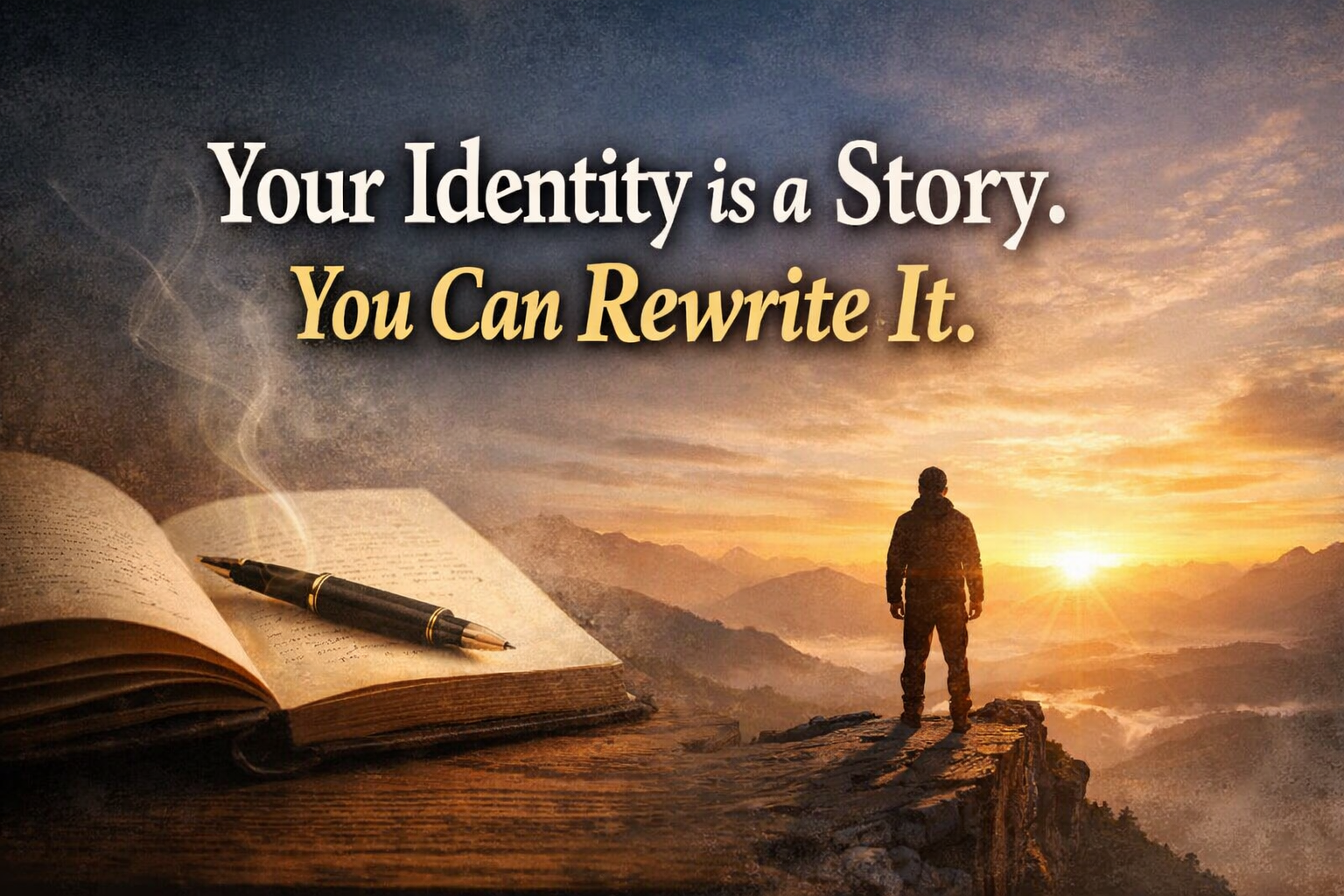
Your identity isn’t a fact. It’s a story.
And stories can be rewritten.
The Story You Were Given
Long before you had any say in the matter, people started writing chapters of your story.
Parents. Teachers. Friends. Bosses. Society.
Sometimes those chapters were helpful.
“You’re resilient.” “You’re a leader.” “You’re capable of great things.”
But often they were limited.
“You’ll never amount to much.” “You’re too emotional.” “You’re not smart enough.” “You’re damaged.”
Most of these labels were never meant to define your entire life.
They were observations. Moments. Opinions.
But when you hear something often enough, it stops sounding like feedback and starts sounding like truth.
And before you know it, you begin acting in ways that reinforce the story you’ve been told.
Not because it’s accurate.
But because it’s familiar.
The Danger of Living Inside an Old Story
Here’s where things get interesting.
The human brain is incredibly good at one thing:
Protecting the story it already believes.
If your internal story says:
“I’m not good with people.”
Your brain will highlight every awkward conversation you have and quietly ignore the dozens that go just fine.
If your story says:
“I always fail.”
Your brain will store every mistake like evidence in a courtroom.
And when something good happens?
It gets dismissed as luck.
This is how identity traps people.
They aren’t living life as it is.
They’re living life through the filter of a story written years ago.
And that story becomes a prison.
The Military Version of the Story
For many veterans and emergency service personnel, identity gets even more complicated.
Because for years, the story was simple.
You had a role.
You had a uniform.
You had a mission.
The structure told you who you were.
Then one day, the uniform comes off.
And suddenly the question appears like an unwelcome guest:
Who am I now?
For some people, that question becomes a crisis.
Because if your identity was built entirely around a role, removing that role feels like removing the foundation of who you are.
But here’s the part no one explains clearly enough.
You didn’t lose your identity.
You just reached the end of one chapter.
The Pen Was Always in Your Hand
This is the moment where most people get uncomfortable.
Because rewriting your story requires something many people avoid:
Responsibility.
Not blame.
Responsibility.
Blame says the past defines you.
Responsibility says the past informed you.
There’s a big difference.
Your experiences matter.
Your trauma matters.
Your victories matter.
But they are chapters, not the entire book.
And you are still writing.
The Trap of the Victim Story
There is a particular kind of story that is incredibly seductive.
The victim narrative.
Now, before anyone throws their phone across the room, let’s be clear.
Bad things happen to people.
Unfair things happen.
Painful things happen.
But there is a difference between experiencing hardship and building your identity around it.
Because the moment your identity becomes “the person bad things happened to,” your future becomes limited to surviving rather than creating.
And surviving, while important, is not the same as living.
Rewriting the Story
If identity is a story, then rewriting it starts with a simple but powerful question:
What story am I currently telling myself about who I am?
Not the story you tell others.
The one running quietly in your head.
Maybe it sounds like:
“I’m too old to start again.”
“I missed my chance.”
“I’m broken.”
“I’m behind everyone else.”
Once you hear the story clearly, something interesting happens.
You realise something.
You didn’t consciously choose most of it.
Which means you can consciously choose something different.
Changing the Narrative
Rewriting your identity doesn’t happen through positive thinking slogans.
It happens through new evidence.
Small actions.
New choices.
Consistent behaviour that contradicts the old story.
If your story says:
“I’m not disciplined.”
Start proving the opposite.
Small commitments.
Daily wins.
Evidence begins stacking up.
Your brain starts noticing something new.
And slowly the old story loses credibility.
Identity Is Built Through Action
People often try to change their identity by thinking differently.
But identity rarely changes through thinking alone.
It changes through doing.
You don’t become confident by thinking confident thoughts.
You become confident by doing difficult things repeatedly until your brain updates the story.
You don’t become resilient by saying you are resilient.
You become resilient by surviving things you once believed you couldn’t.
Your actions write the chapters.
The Spiritual Perspective
From a deeper perspective, identity becomes even more interesting.
Because beneath all the labels, roles, and stories, there is something quieter.
Something constant.
Call it consciousness.
Call it the soul.
Call it awareness.
Whatever language you prefer, it’s the part of you that observes the story rather than being trapped inside it.
And when you recognise that, something powerful happens.
You realise:
You are not just the character in the story.
You are also the author.
The Most Powerful Question You Can Ask
Instead of asking:
“Why did this happen to me?”
Try asking:
“Who do I want to become because of this?”
That single shift turns pain into material.
Adversity becomes character development.
Struggle becomes transformation.
Suddenly, the story isn’t about what happened.
It’s about whom you choose to become next.
The Chapter You’re Writing Now
Every day you make choices.
Most of them feel small.
Wake up.
Go to work.
Have a conversation.
Try something new.
Quit something old.
But each one of those choices writes a sentence.
Those sentences form paragraphs.
Paragraphs become chapters.
And before you know it, you’ve written an entirely new identity.
Not because someone gave it to you.
Because you created it.
The Truth Most People Never Realise
You don’t find your identity.
You build it.
One decision at a time.
One action at a time.
One chapter at a time.
And the most important part?
No matter how messy the previous chapters are…
The next page is still blank.
Which means you still get to decide how the story continues.
