
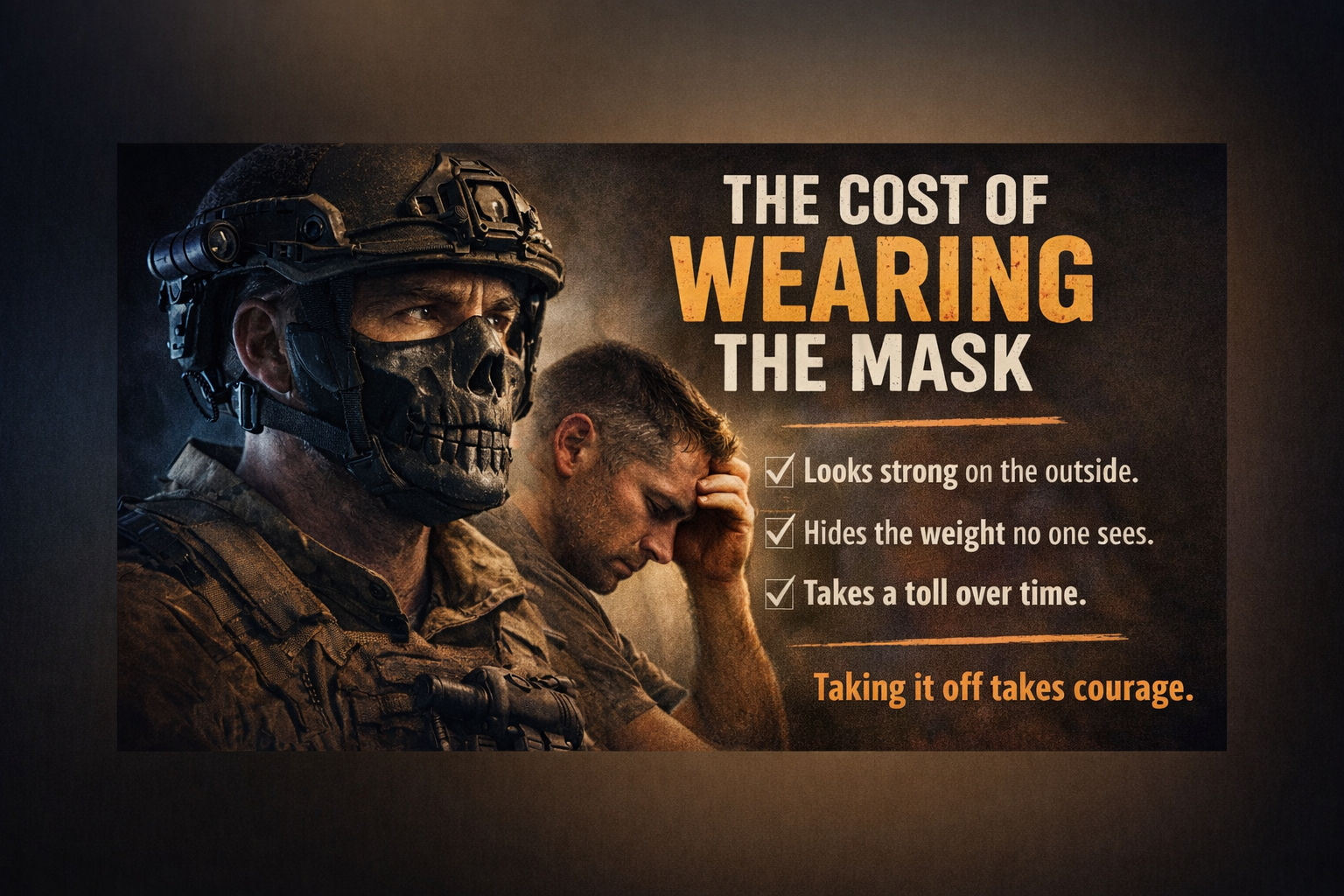
There’s an unspoken rule in the military and emergency services.
You don’t show weakness.
You get on with the job. You carry the weight. You keep the wheels turning.
And if something breaks inside you along the way… You deal with it quietly.
Over time, most people in these professions learn to wear what can only be described as a mask.
It’s the mask that says “I’m fine.” The mask that laughs at the dark jokes. The mask that shows up to work, performs, leads, protects, and keeps everything moving.
From the outside, the mask looks like strength.
But what most people don’t realise is that wearing the mask comes at a cost.
The Mask Is Part of the Culture
The mask isn’t something people consciously choose.
It grows out of the culture.
When your job involves responding to trauma, chaos, death, danger, and human suffering, there isn’t always time to stop and process what you’ve just seen.
You move to the next job.
Then the next one.
Then the next one.
Over time, you learn to compartmentalise. You put things in boxes in the back of your mind so you can keep functioning.
At first, this ability is actually helpful. It allows people to perform in environments where most others couldn’t.
But the problem is that those boxes never disappear.
They just quietly stack up.
The Weight No One Sees
What makes the mask so powerful is that it hides the weight people are carrying.
Colleagues see competence.
Family sees someone who is tired but “handling it.”
The public sees a professional doing their job.
What they don’t see is the accumulation of years of experiences that were never properly unpacked.
The jobs that stay in your head.
The calls you replay.
The moments you wonder if you could have done something differently.
The things you saw that you can’t easily explain to someone who wasn’t there.
Eventually, carrying that weight quietly starts to take its toll.
Not always in dramatic ways.
Sometimes it shows up slowly.
Fatigue that never seems to go away.
Short tempers.
Emotional numbness.
Disconnection from the people you care about.
A sense that something isn’t quite right anymore.
The Mask Starts to Become the Identity
One of the most difficult parts about the mask is that, over time, it stops feeling like something you wear.
It starts feeling like who you are.
You become the person who holds it together.
The one who doesn’t complain.
The one others rely on.
And because of that, taking the mask off can feel incredibly uncomfortable.
It can feel like vulnerability.
It can feel like failure.
It can even feel like you’re letting people down.
So the mask stays on.
Even when the cost of wearing it keeps growing.
When the Mask Becomes Heavy
Eventually, many people reach a point where the mask begins to slip.
Sometimes it happens after a particularly difficult job.
Sometimes it comes after years of accumulated pressure.
And sometimes it appears during transition, when someone leaves the military or emergency services and suddenly loses the structure and identity that once held everything together.
Without the uniform, the team, and the mission, the mask can start to crack.
And that’s when people realise just how much they’ve been carrying.
The Courage to Take the Mask Off
In many ways, the bravest thing someone can do after a career of service is take the mask off.
Not dramatically.
Not all at once.
But slowly, in safe spaces, with the right people around them.
It means allowing conversations that normally never happen.
It means acknowledging that strength doesn’t always look like pushing through.
Sometimes strength looks like being honest about where you are.
It means recognising that the experiences of service shape people deeply, but they don’t have to define the rest of their lives.
What Real Recovery Looks Like
Real recovery doesn’t mean forgetting the past.
It doesn’t mean pretending things never happened.
And it certainly doesn’t mean someone is broken.
Recovery is about learning how to carry those experiences differently.
It’s about reconnecting with purpose, identity, and meaning outside the roles people once held.
It’s about understanding that the qualities developed through service, resilience, leadership, loyalty, and courage still exist.
They just need a new place to live.
The Mask Isn’t the Enemy
Interestingly, the mask itself isn’t the enemy.
At one point, it helped people survive and perform in environments that demanded extraordinary strength.
But what once protected people can eventually start to isolate them.
And that’s where the shift begins.
Not by tearing the mask off.
But by slowly recognising that you don’t have to wear it all the time anymore.
A Different Conversation
Across the veteran and emergency services community, conversations around mental health and wellbeing are slowly changing.
There is growing recognition that strength and vulnerability are not opposites.
They are part of the same story.
Behind every uniform is a human being who has seen, carried, and endured more than most people realise.
And sometimes the most powerful step forward is simply creating spaces where the mask can be set down, even if only for a little while.
Because when that happens, something important becomes possible.
Connection.
Understanding.
And the realisation that no one has to carry it all alone.
