
If you know my story, you’ll know this isn’t coming from the cheap seats.
I’ve been in dark places. I’ve been lost. I’ve questioned my worth, my direction, and my place in the world after service.
So this isn’t a judgment. It’s a reflection. And it’s a conversation worth having.
I’ve been sitting with a question lately, the kind that doesn’t leave you alone once it shows up.
As a Veteran community, have we lost sight of who we were… and what we did?
When we served, we carried ourselves differently. There was pride in putting the uniform on. There was strength, not just in our bodies, but in our minds. There was courage, loyalty, dark humour, and a willingness to run toward things most people spend their lives avoiding.
And let’s call it what it is, signing up knowing you could be sent into harm’s way, possibly never coming home, isn’t normal behaviour.
It’s brave. It’s selfless. And it’s just a little bit crazy, the good kind.
That mindset didn’t come from nowhere. It came from values. From belief. From purpose. From knowing you were part of something bigger than yourself.
Shit, some of us even came from broken families, shitty childhoods and even worse, and we still managed to join up and offer up the greatest sacrifice of service so others could have the freedom to live.
So what happened?
Yes, things happened. Real things. Bodies broke. Minds took hits. Relationships suffered. Identity cracked.
Injuries don’t ask permission. Trauma doesn’t care how tough you are. Life doesn’t pull its punches just because you served.
And I want to be clear, none of this is about dismissing pain or pretending suffering doesn’t exist. That would be dishonest and harmful.
But here’s where the conversation gets uncomfortable.
Somewhere along the line, the story shifted.
From “I served” to “I’m broken.”
From “I’m rebuilding” to “I’ll never be able to work again.”
From “This happened to me” to “This defines me.”
And quietly, almost invisibly, responsibility got outsourced.
To Defence. To DVA. To the system. To the government. To everyone else.
Now, don’t misunderstand me, systems should work. Support should exist. Accountability matters.
But here’s a truth we rarely want to face:
Every situation is 50 per cent owned by us.
Not blame. Ownership.
Ownership of how we respond. Ownership of how long we stay stuck. Ownership of whether we heal or harden.
And in many ways, we’ve unintentionally messed up the process.
We’ve become hyper-focused on compensation. On diagnoses. On evidence. On payouts. On the dollar value attached to suffering.
Pain has become transactional.
And yes, money helps. Anyone who says it doesn’t is lying or privileged. It reduces pressure. It creates options. It can provide stability when life feels like it’s falling apart.
But money is not the solution.
Because if you are not enough without it… you will never be enough with it.
Compensation doesn’t restore identity. It doesn’t give you purpose. It doesn’t answer the question of who you are when the uniform comes off for good.
It can support healing, but it can’t replace it.
What actually helps is remembering.
Remembering who you were before the injury. Before the diagnosis. Before the paperwork. Before your life became measured in appointments and acronyms.
You were someone who committed. Someone who endured. Someone who adapted. Someone who kept going when quitting would’ve been easier.
That person didn’t disappear; they went quiet.
And maybe the hardest part of transition isn’t what happened to us…
It’s what we stopped believing about ourselves.
At some point, many of us were told, directly or indirectly, that we are fragile now. That we should lower expectations. That risk is dangerous. That pushing forward is reckless. That safety lives in smallness.
But that mindset doesn’t align with who we were built to be.
Strength doesn’t mean ignoring pain. Courage doesn’t mean pretending everything’s fine. Resilience doesn’t mean doing it alone.
It means holding two truths at the same time:
“I was hurt.” and “I am still capable.”
Victimhood feels safer in the short term. It explains everything. It removes pressure. It gives the pain somewhere to live.
But it also shrinks your future.
Growth is harder. It requires honesty. Responsibility. Patience. Self-compassion without self-pity.
It asks you to look at your life and say, “This happened, and I still choose to live.”
The Veteran community has always been strongest when we lead by example, not when we compete over suffering.
We don’t need to erase the past. We don’t need to deny injury. We don’t need to pretend we’re invincible.
But we do need to remember that service didn’t end our story.
It shaped us. It tested us. It proved something about who we are.
And that identity, the one built on values, courage, and commitment, still exists.
Not as nostalgia. As a foundation.
Because being a Veteran was never about what broke you.
It was about what you were willing to stand for.
And we control the narrative.
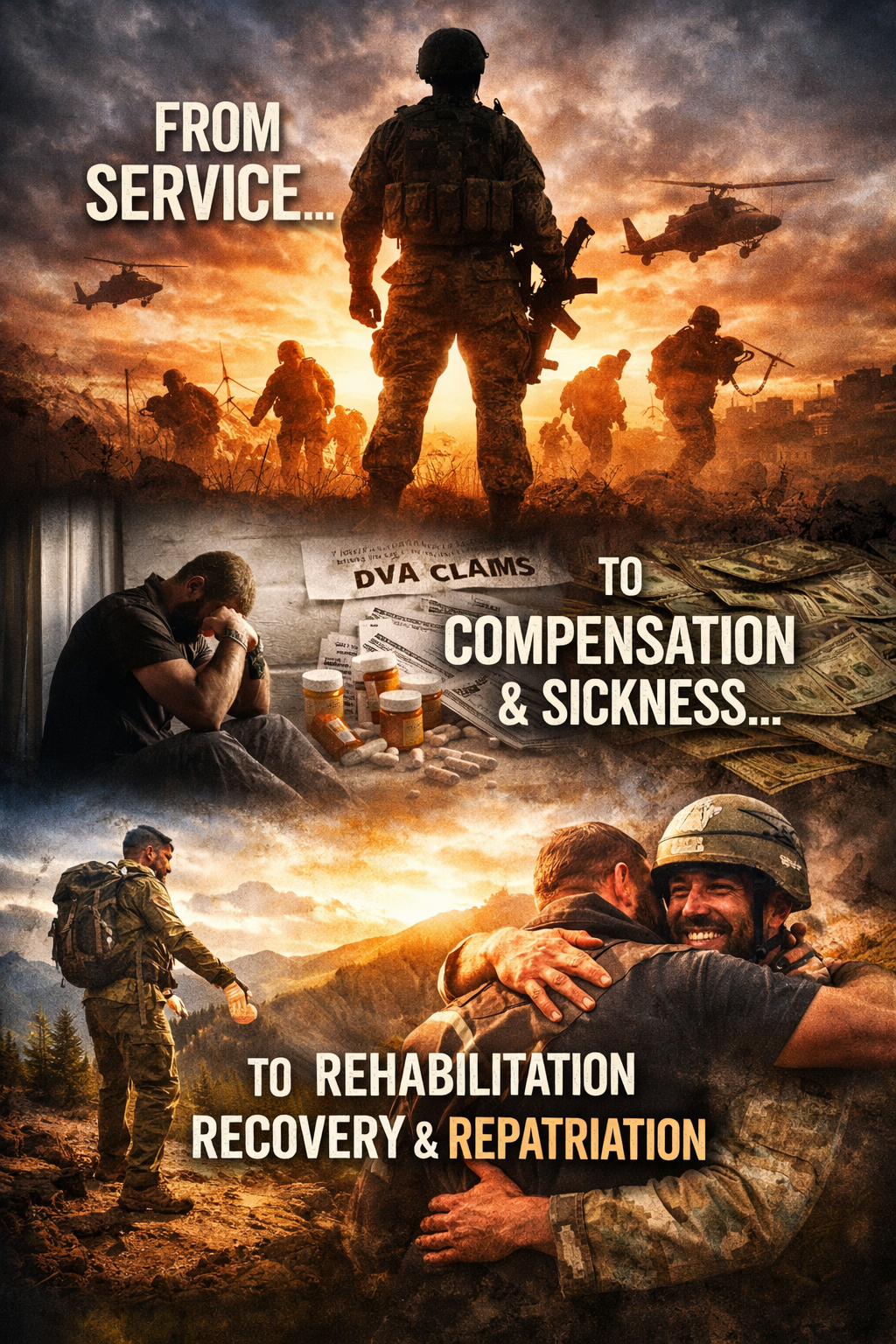
It’s time we move away from a model built purely on compensation and sickness, and toward one grounded in rehabilitation, recovery, and repatriation, one that helps us heal, rebuild, and move forward into the lives we actually want to live now.
What is it you actually want to do with your life?
Remember, you are an amazing human being.
