
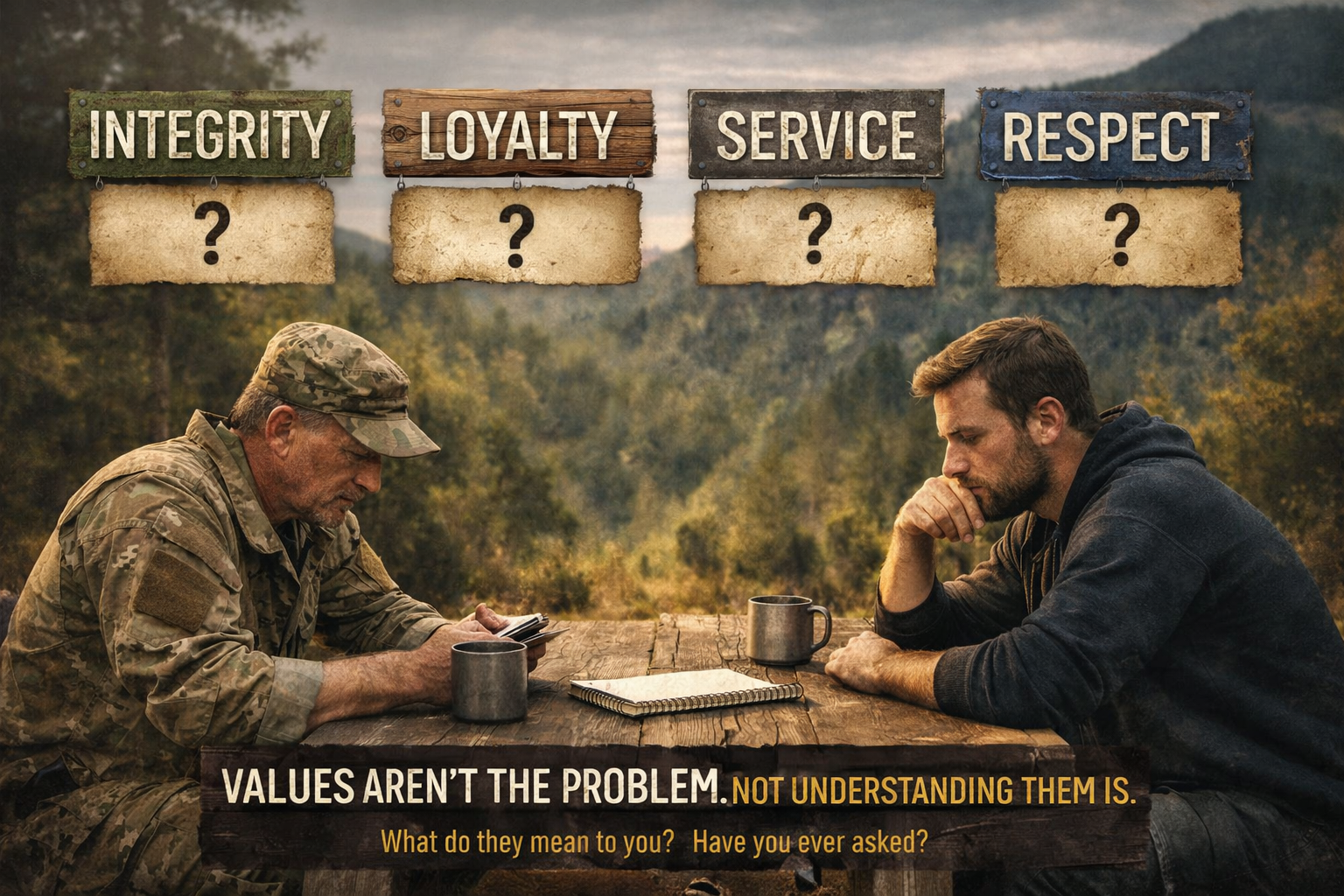
Everyone says they have values.
They’re on walls. In mission statements. In onboarding packs, no one really reads.
The military has them. Police do. Emergency services live by them. Companies love them.
Integrity. Service. Respect. Loyalty, etc.
Big words. Heavy words. Words that sound great when spoken slowly by someone in authority.
But here’s the part that rarely gets said out loud:
You had values before you ever joined any of those places, and some come and go over time.
Before the uniform. Before the badge. Before the contract and the code of conduct.
You didn’t walk in empty.
When values stop being personal
Organisations define values for function, not meaning.
They need order. Control. Predictability under pressure.
So values become operational.
Integrity becomes:
Don’t embarrass the organisation.
Loyalty becomes:
Protect the system. Protect the brand.
Service becomes:
Sacrifice, repeatedly, and don’t ask too many questions.
And that’s not evil. It’s institutional.
The problem is this:
You took those same words and filled them with your own meaning, shaped by your life, your ethics, your sense of right and wrong.
And no one ever asked:
“What does this value actually mean to you?”
Where the real damage starts
For many who’ve served in your home country and overseas.
You’re placed in environments where:
- You see things that contradict your values
- You’re unable to act because of rules, politics, or orders
- You’re told why something can’t be done, while every part of you knows it should be
You watch people suffer. You watch behaviour you don’t agree with. You watch decisions made that cut directly across your moral compass.
And you carry it, because you have to.
That quiet helplessness? That’s not a weakness.
That’s values under pressure with nowhere to go.
Same values. Different meanings.
It doesn’t stop there.
Sometimes the injury comes when you question the organisation’s values, not because you’re difficult, but because you’re trying to understand them.
You ask:
- “How is this integrity?”
- “Who are we actually serving here?”
- “How does this align with what we say we stand for?”
And instead of conversation, you get resistance.
Because the organisation understands the word, but not your meaning of it.
That gap doesn’t feel like a disagreement.
It feels like betrayal.
Moral injury and identity loss
Moral injury isn’t just about what you did or didn’t do.
It’s about who you thought you were while you did it.
Most veterans, emergency services personnel, and people in general don’t break down because they lack resilience.
They leave fractured because their values were slowly bent, redefined, or violated, and no one helped them make sense of it.
One day you realise:
“I don’t recognise myself anymore.”
That’s identity loss.
When your actions no longer align with your definition of integrity, loyalty, service, etc, something has to give.
Usually, it’s you.
Now look at society
Zoom out, and you’ll see the same pattern everywhere.
Everyone’s defending their values. Almost no one is curious about anyone else’s.
We argue. We judge. We harden.
Rarely do we ask:
“What does that value mean to you, and where did it come from?”
Imagine a world where, before tearing someone apart for their beliefs, we asked questions instead of throwing labels.
Understanding wouldn’t fix everything.
But it would stop us bleeding each other out over assumptions.
So here’s the invitation
What are your values?
Not the organisation’s. Not the inherited ones. Not the ones that sounded noble at the time.
Yours.
Write them down. I’m not saying 20, more like seven. Then write what each one actually means to you, in plain language. Not the dictionary meaning. Then, could you write what it feels like to violate them or when that value is crossed?
Now do something most people avoid.
Ask a friend or family member to do the same. Sit down. Compare. Talk about it.
You’ll probably discover you’ve been using the same words for years, while meaning completely different things.
Final thought
Values aren’t the problem. People aren’t the problem.
Understanding and unexamined meaning is.
My opinion is that if we want less moral injury, less identity loss, and less division, it starts with understanding our own values, then asking others about theirs.
Everything else is just noise.
