
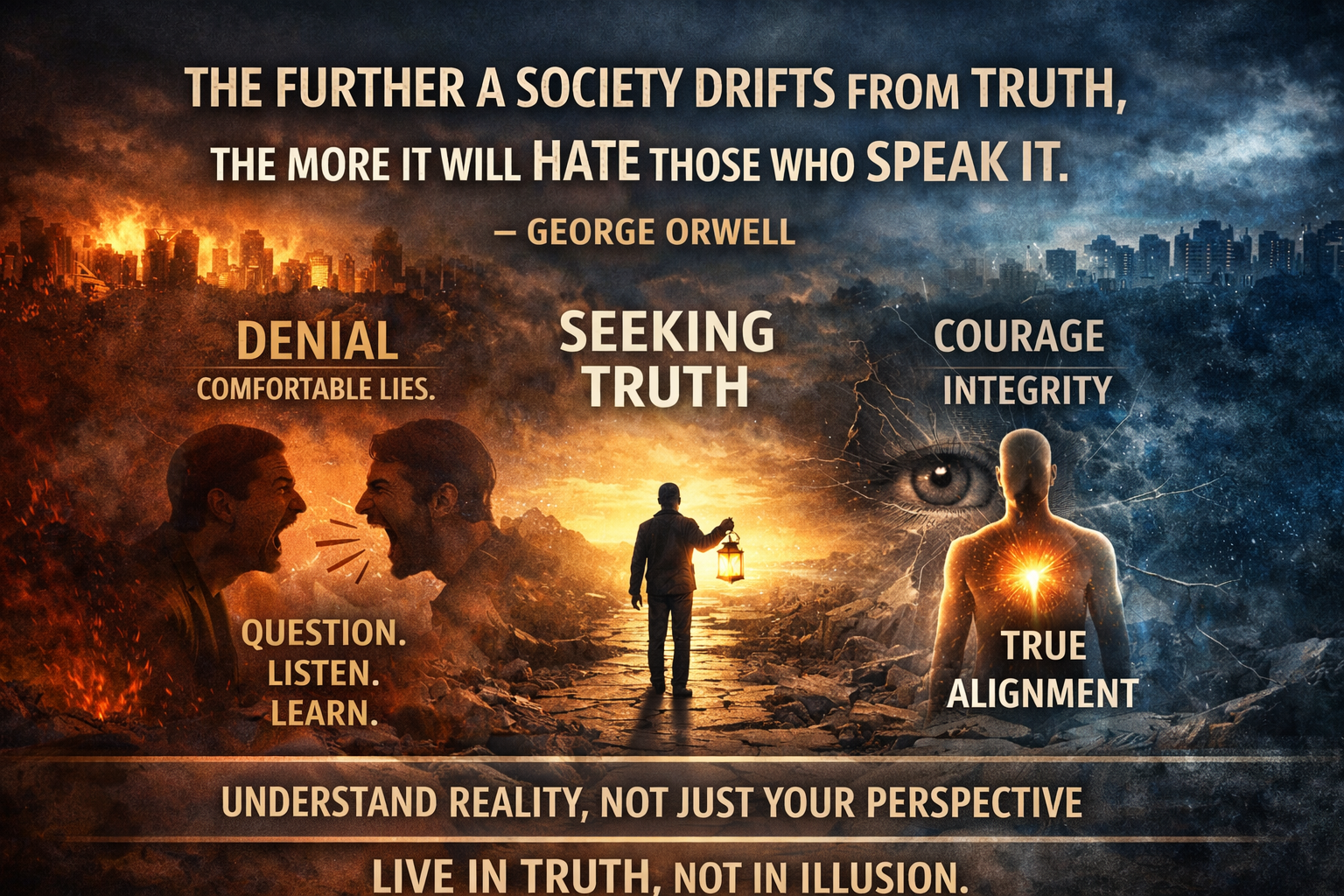
“The further a society drifts from truth, the more it will hate those who speak it.” George Orwell
There is something unsettling about that quote.
It doesn’t say society will debate those who speak the truth. It doesn’t say it will question them.
It says it will hate them.
Why?
Because truth has weight, truth disrupts comfort. Truth threatens systems built on illusion.
But before we can understand why truth is hated, we have to ask a more uncomfortable question:
What is truth?
What Is Truth, Really?
We often speak about truth as if it’s obvious. As if it’s simple. As if everyone agrees on what it means.
But consider this statement:
“What is truth but simply your interpretation of events from your perspective?”
At first glance, that sounds reasonable. After all, every human being sees the world through their own lens, shaped by experience, upbringing, trauma, education, belief systems, culture, and emotion.
Two people can witness the same event and walk away with two entirely different accounts.
So is truth just perspective?
Partially.
But not entirely.
Truth as Correspondence to Reality
Traditionally, truth has been defined like this:
A statement is true if it corresponds to reality.
If I say, “It’s raining,” and rain is objectively falling from the sky, the statement is true. If not, it’s false.
This is an observable, measurable truth. It doesn’t bend to feelings.
Science operates largely in this realm. Gravity does not change because someone disagrees with it.
There are objective truths that exist whether we like them or not.
And yet, human conflict rarely centres on whether gravity works.
It centres on meaning.
Truth as Interpretation
Where things become complex is in interpretation.
Events are objective. Meaning is interpretive.
For example:
- A leader enacts a policy.
- An officer gives an order.
- A partner walks away.
The event occurred. That’s objective.
But what it means, whether it was justified, oppressive, wise, selfish, necessary, cruel, strategic, or compassionate, that interpretation is shaped by perspective.
And this is where societies begin to drift.
Because when perspective becomes elevated above reality itself, truth becomes fluid.
And when truth becomes fluid, power steps in.
Truth as Coherence and Systems
Another way to understand truth is coherence.
Something feels “true” when it fits within our existing worldview.
If new information aligns with our beliefs, we accept it easily.
If it contradicts them, we resist.
Not because it’s false.
But because it disrupts internal order.
Societies do this collectively.
Entire cultures can construct narratives that feel coherent, stable, and morally justified. When someone introduces a truth that fractures that coherence, it creates instability.
And instability feels dangerous.
So instead of re-evaluating the narrative, societies often attack the messenger.
Orwell understood this deeply.
The Hatred of Truth-Tellers
Why does society hate those who speak truth when it drifts from it?
Because truth exposes:
- Hypocrisy
- Corruption
- Self-deception
- Moral compromise
- Comfort built on illusion
Truth removes the luxury of denial.
And denial is a powerful survival mechanism.
If a society has slowly normalised dishonesty, injustice, or self-serving narratives, then someone speaking the truth doesn’t just present new information.
They threaten identity.
They threaten power structures.
They threaten emotional comfort.
Truth becomes experienced not as illumination, but as attack.
And when people feel attacked, they retaliate.
The Pragmatic Layer: What “Works”
There’s another angle.
Some argue that truth is what works.
If a belief consistently produces reliable outcomes, it functions as truth.
But here’s the danger: short-term success can mask long-term falsehood.
A lie can “work” for years.
A distortion can “work” politically.
Propaganda can “work” socially.
But what “works” in the short term often collapses under reality in the long term.
And when collapse comes, the hatred intensifies.
Because truth doesn’t just expose error, it exposes time lost defending it.
Objective vs. Subjective Truth
Confusion escalates when we blur the lines between objective and subjective truth.
Objective truth:
- Exists independent of belief.
- Can be tested.
- Does not change based on opinion.
Subjective truth:
- Describes lived experience.
- Is emotionally real.
- May differ between individuals.
Both matter.
But when subjective experience is elevated to the level of objective fact, or when objective fact is dismissed because it feels uncomfortable, societies drift.
The further they drift, the more fragile they become.
And fragile systems cannot tolerate truth-tellers.
Psychological Truth
There is yet another layer.
Some stories are not factually precise but are psychologically true.
Myths. Parables. Allegories.
They communicate something deeply real about human nature, even if not historically verifiable.
But even psychological truth requires integrity.
Because when narrative replaces reality entirely, we move from meaning into manipulation.
Truth must remain anchored to something solid.
Otherwise, it dissolves into preference.
The Real Struggle: Acceptance
Most people do not struggle to find the truth.
They struggle to accept it.
Truth costs:
- Ego
- Reputation
- Relationships
- Comfort
- Power
- Identity
Sometimes it even costs belonging.
And belonging is one of the deepest human needs.
So when someone speaks the truth that challenges the group’s identity, the group reacts as if its survival is threatened.
Because in a way, it is.
Not physical survival.
But social survival.
The Goal of Understanding: Seek to Understand
If truth can be distorted by perspective, and if societies drift through collective narratives, how do we move closer to it?
Here is the key:
The goal to understand the truth is to seek to understand.
Not to win. Not to dominate. Not to defend ego. Not to reinforce identity.
To understand.
That requires humility.
It requires asking:
- What am I missing?
- What would the opposing side say?
- Where might my interpretation be shaped by fear?
- What evidence contradicts my view?
Truth-seeking is not loud. It is not performative. It is not reactive.
It is disciplined curiosity.
And that is rare.
On a Deeper Level
Now we move beyond society.
Beyond philosophy.
Beyond politics.
Truth is not only something “out there” in culture.
It is something inside.
You can know objective facts and still live falsely.
You can claim to value integrity and compromise it when convenient.
You can say you want truth, but avoid conversations that might expose your own contradictions.
At the deepest level, truth is alignment.
Alignment between:
- What you believe
- What you say
- What you do
This is existential truth.
Not just, “Is this statement correct?”
But:
“Am I living in alignment with what I know?”
That question is far more dangerous than any political debate.
Because it removes excuses.
It asks whether your life corresponds to reality.
Whether your values correspond to your actions.
Whether your identity corresponds to your behaviour.
Truth, at its core, is reality revealed.
Whether we like it or not.
And perhaps Orwell’s warning is not only about society.
Perhaps it is also about the individual.
The further a person drifts from their own truth, the more they will resent the voice, internal or external, that speaks it.
Which leaves us with the most confronting question of all:
Are we seeking truth…
Or defending our version of it?
Because the goal to understand the truth is to seek to understand.
And that begins not with shouting.
But with listening.
First to others.
Then to ourselves.
