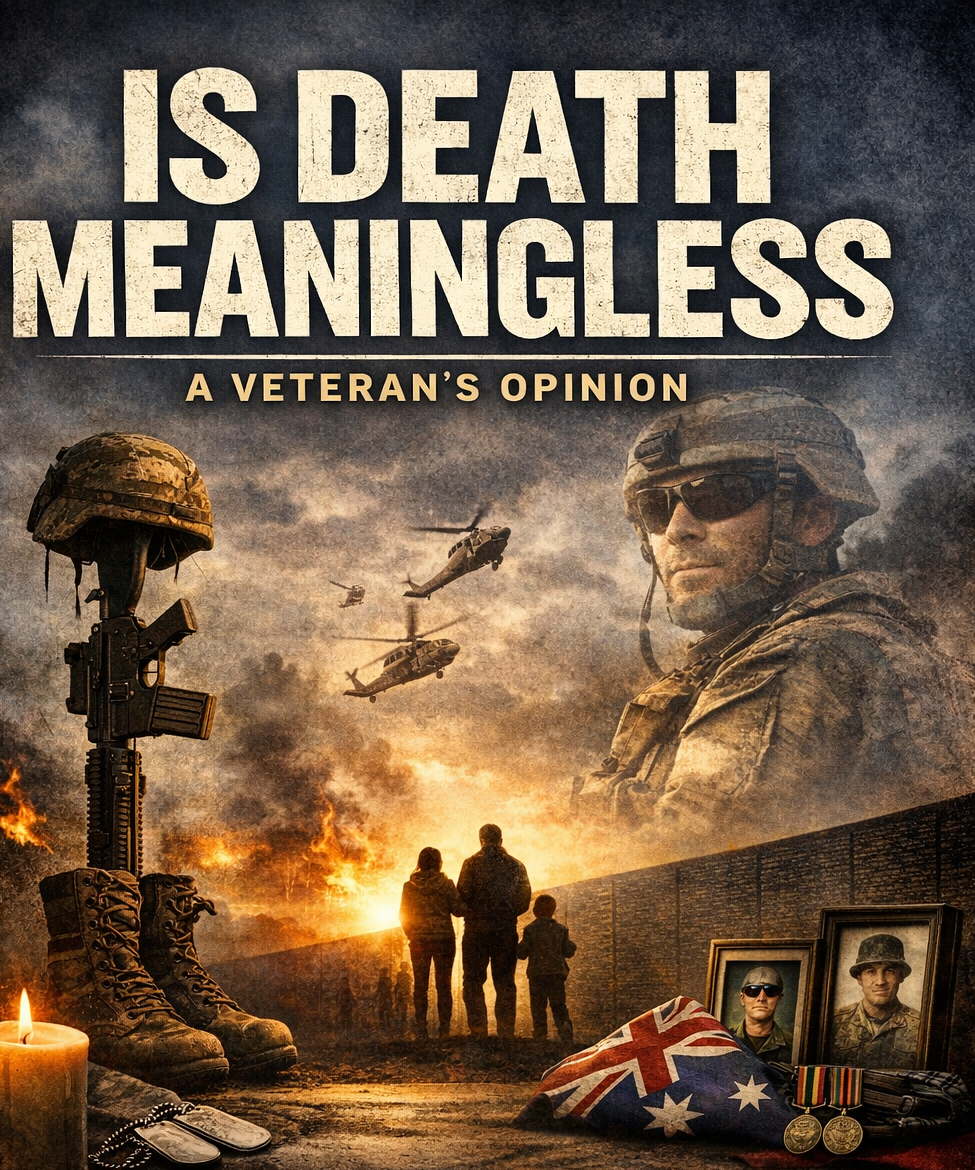
My Perspective on Death, Meaning, and the Bigger Play of Life
The other day, I overheard a conversation (more like eavesdropping). Two people arguing like they were trying to out-philosophise each other at a pub trivia night about “Is Death Meaning Less?” One of them was swearing black and blue that death means nothing, as if it wasn’t going to happen to them. The kind of confidence that only comes from two places: fear… and the absolute belief that they’re the exception to the entire biological rulebook.
And I just sat there thinking, Mate… the universe is undefeated. You’re not walking away from this one. Unless they had some secret superpower, I didn’t know about which I now wanted.
But in all seriousness, that conversation stuck with me. Not because they were wrong, people are wrong all the time, but because it came from a place I recognised. That raw human fear of the one thing we can’t negotiate, fight, outsmart, or shove into a “later” basket. Death.
Most people tiptoe around it as if saying the word out loud will summon it like some cosmic Bloody Mary. But those of us who’ve brushed up against it, military, ambos, firies, veterans, and everyday people have had a brush with death, don’t get the luxury of pretending it’s optional. We’ve danced with it enough times to know its steps. Hell, some of us have led the dance.
And after living long enough in those worlds, here’s the uncomfortable truth:
We don’t fear death. We fear losing control.
That’s the part no one wants to admit. We’re trained to outthink danger. To dominate chaos. To keep everyone else breathing. So the idea that something can snatch us away, no prep, no tactics, no fallback plan, hits right in the bloody ego.
But here’s a more spiritual punchline:
We were never steering the wheel anyway. Life was the whole time. We were just holding the grab handles, pretending to help, because we had forgotten why we were here.
Strip away the trauma, the uniforms, the conditioning, the medals, the stories, and you realise something oddly comforting. Before we were born, we weren’t anywhere. No fear. No pain. No memory. Just the quiet nothingness of “not existing.” And not once did that bother us.
So why be terrified of returning to the same place?
That’s the symmetry I’ve made peace with.
Here’s where my view really sharpens:
Death isn’t the opposite of life. It’s a necessary part of it. One step in the rhythm. One beat in the pattern.
And the most painful truth? Meaning often shows up after the death, not before. But meaning doesn’t magically come from a death. Meaning comes from what the living choose to build afterwards.
Just like I talked about in another article. Life must be lived forward but only understood in reverse. We finally understand the meaning when we mourn, let go of the ego, anger and hate.
Look at what veteran suicides eventually forced this country to face. We lost mates, brothers, sisters, far too many, for far too long. And only then did the nation finally admit out loud what we already knew: the system was failing us. Those deaths shook the country awake. They led to the Royal Commission. To reform. To people refusing to be silent anymore.
The loss was tragic. But the response became meaningful.
Look at Daniel Morcombe. One child taken. His parents took their grief and built a foundation that has protected and educated an entire generation. Legislation changed. Awareness exploded. Lives were saved. Not theoretically, literally.
Look at Jack Beasley. A kid out on a night that should’ve ended with greasy food and a taxi home, but didn’t. His family fought, and fought, and fought, until Jack’s Law became a reality. Now, thousands of Australians are safer every weekend because one family refused to let their son’s story end at the crime scene.
Look at Robert Poate, killed in Afghanistan. A family shattered in ways words don’t cover. Yet his family transformed their land into a healing place for veterans that Trojan’s Trek now uses. People find clarity on that soil. Trauma cracks open there. Light gets in. Lives change because of Robert. His death didn’t stop his impact; it widened it.
And then there’s Luke Worsley, a close friend of mine. The date I’m writing this is the anniversary of his passing in Afghanistan. Luke was a gentle giant, spiritual and kind, one of those people who made you want to be better just by existing. Remembering him doesn’t drag me down; it makes me want to live the life he never got to live. That’s his legacy, still shaping me.
Here’s what I do believe:
We forget why we chose to come here. Sometimes death shakes us awake and reminds us. Then we decide what happens next.
Meaning isn’t pre-packaged inside the tragedy. Meaning is carved from the rubble, through action, memory, change, and legacy.
We mourn, and we need to. We feel the hole, and we should. But then we honour the life by what we build in the space they leave behind.
Grief is the explosion. Legacy is the reconstruction. Perspective is what lets you see both without drowning.
To me, that’s the bigger play of life. That’s the script we’re all acting in, even if we didn’t audition.
And no, this perspective doesn’t make death easier. But it does make it mean something.
Not because the universe says so. But because we decide it will.
Finally, go out and live, explore and experience everything this world has to offer. The good, the bad, and the ugly.
And remember you are F%$ken amazing.
